

Guides
Food grade paper in India
A food-contact sheet has to fit the food and the job. Start with direct contact, heat, oil and time. Then ask for evidence on the exact material you plan to use.
01 / Meaning
What food grade means
FSSAI defines food grade as material made from substances safe and suitable for the intended use. The material must not endanger health or create an unacceptable change in food composition, taste, smell or appearance. The intended use is part of the answer. A sheet suitable for a cold dry biscuit needs a separate assessment before you use the same sheet against hot oil.
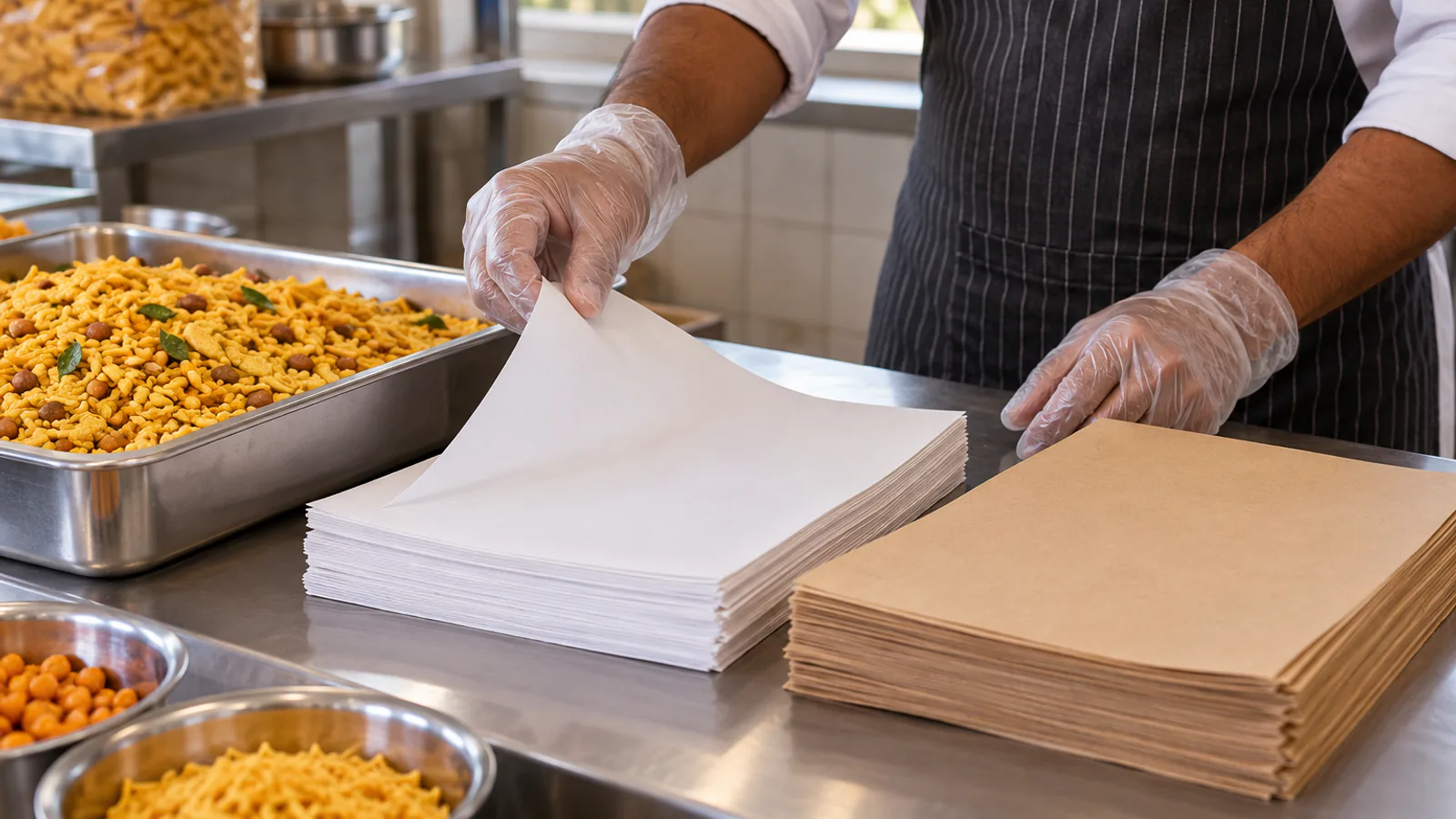
Food grade is not a paper colour, a GSM value or a marketing stamp. Brown kraft, white board and translucent butter paper describe appearance or construction. None of those names alone proves food-contact suitability. Ask for the exact material, treatment, coating and use conditions. Compare the supplied evidence with your food and process.
Direct contact means food touches the packaging surface. A separate outer carton has a different job. FSSAI calls direct-contact material primary packaging and an outer layer without food contact secondary packaging. Check the inside surface of every box, wrap and liner. A printed or recycled outer layer still needs an appropriate inner layer when the outer material lacks direct-contact evidence.
02 / Rules
The Indian packaging rules
The Food Safety and Standards Packaging Regulations, 2018 set general and material-specific requirements. Paper for direct contact must be food grade and free from contaminants. Paper and board should have uniform formation, thickness and substance, without visible specks, grease marks, cuts, pinholes or other blemishes. Materials also need to suit normal mechanical, chemical and thermal stresses.
Schedule I names Indian Standards for greaseproof paper, vegetable parchment or greaseproof laminates, general packing or wrapping paper, board and corrugated boxes. A named standard gives you a question for the supplier. A product label mentioning a standard is not the same as a laboratory certificate for the material you will receive.
The regulations say a food business operator must obtain a certificate of conformity from a NABL accredited laboratory for packaging in direct contact with food, or a layer likely to touch food. Ask which construction and batch the certificate covers. We do not publish such a certificate for KEIKO stock today. Send us your intended use and ask what documentation is available before a direct-contact order.
03 / Food
Match the paper to your food
Start with the real food. Dry rusks, oily pakora, damp mithai and frozen patties place different demands on a sheet. Record whether the food is dry, wet or oily. Record whether the surface touches sauce, fat or steam. State how long the food stays wrapped, including transport and storage.
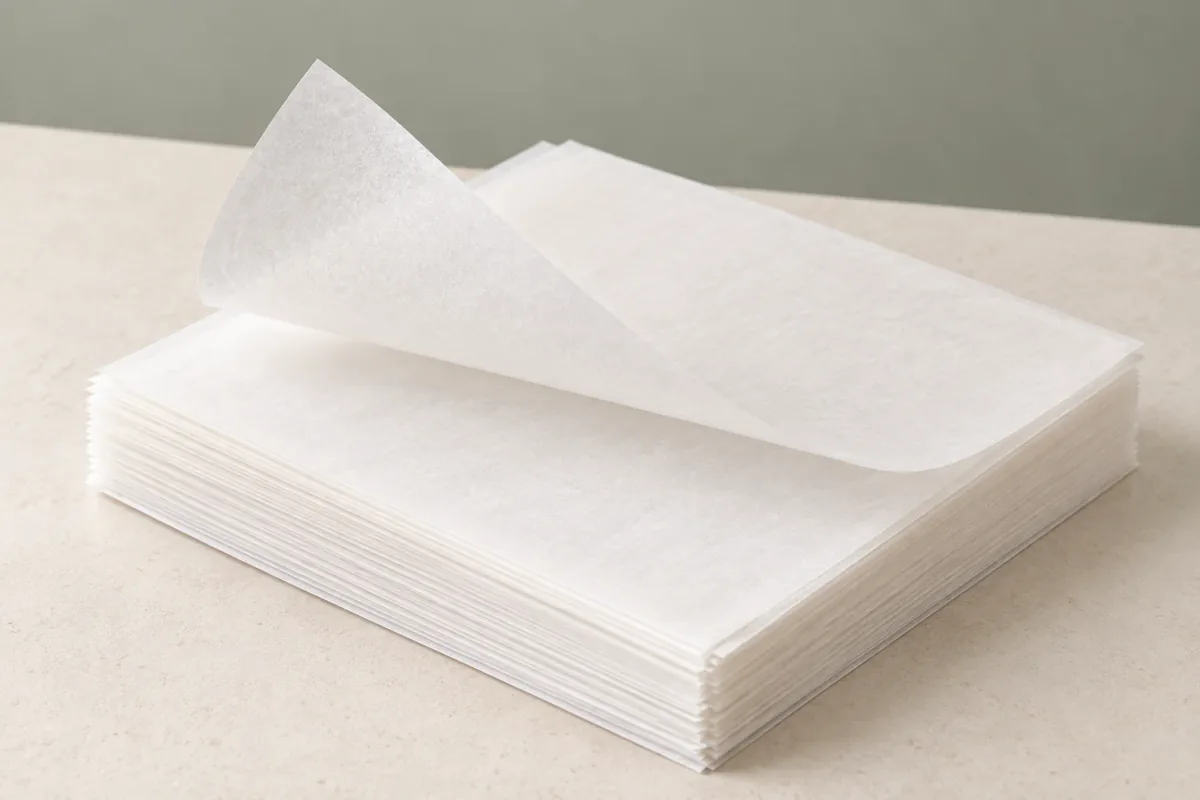
A grease barrier matters for fried and oily food. KEIKO lists white and brown OGR for the wrapping job. Butter paper serves tray lining, light wrapping and separating layers. Those grade pages describe the application. Neither page supplies a batch certificate or a universal promise for every food. Test the exact paper with your food and request the needed documents.
A food wrap also has to hold together in handling. Test folds, corners and damp contact over the full service interval. Keep a sample from the candidate batch. Record leaks, fibre shedding, transfer, odour and visible changes. Use the result to narrow candidates, then confirm the safety documents before you approve direct contact.
04 / Heat
Heat needs a separate check
A food-contact statement does not establish oven performance. Heat changes the job. Ask for a temperature limit tied to the exact paper type and exposure. Do not infer an oven rating from a food-safe label. Keep loose paper away from heating elements and open flames.
KEIKO supplies three butter-paper types. The owner supplied a 230 °C rating for the silicone-coated type, including KEIKOwrap retail rolls. No oven rating was supplied for the vegetable parchment or greaseproof uncoated types. Specify the silicone-coated type when your job includes oven heat. Check the temperature page before you buy.
Serving hot food is another use condition. A wrap around hot roti, a tray liner under a fresh puff and a sheet in an oven face different temperatures and contact times. Give your supplier the starting food temperature and how long food remains against the paper. Ask for suitability for those conditions instead of treating all hot uses as one.
05 / Print
Keep printed surfaces away from food
FSSAI requires printing inks on food packages to conform to IS 15495. The printed surface must not directly contact food. This rule applies even when the base sheet is suitable for food contact. A beautiful print cannot replace a clear contact-side specification.
When you order a printed wrap, identify the inside and outside faces on the drawing. Ask the converter how the sheet is stacked, rolled and packed after printing. A transferred print mark on the food side needs investigation before use. Keep the plain contact face against the food and the printed face outward.
For a multilayer wrapper, the layer touching food and any layer likely to touch food must meet the material requirements. A barrier layer is part of the final construction. Ask for evidence on the finished pack, not only a statement about an unprinted base reel.
06 / Fibre
Recycled fibre needs its own evidence
Recycled fibre describes a source, not a direct-contact approval. Recovered paper brings a different input stream from virgin pulp. The German Federal Institute for Risk Assessment advises careful sorting, cleaning and checks for substances from inks and adhesives when recycled fibre becomes food-contact paper.
The Indian packaging regulation requires direct-contact paper to be food grade and free from contaminants. The regulation does not give a blanket approval to every recycled sheet. Do not assume a plain brown or recycled label establishes safety. Ask for the finished material specification and conformity evidence for your intended food.
An outer recycled carton and an inner contact liner have different roles. Identify whether food ever touches the outer board during filling, transport or serving. If food touches the board, treat the board as a contact layer in your review.
07 / Exclusion
Keep newspaper out of food wrapping
FSSAI expressly bars newspaper or similar material from storing and wrapping food. Printed newsprint is not a substitute when plain food paper runs out. The rule sits in the Packaging Regulations, not only in a recent news report. The Western Region repeated the direction to food businesses in June 2026.
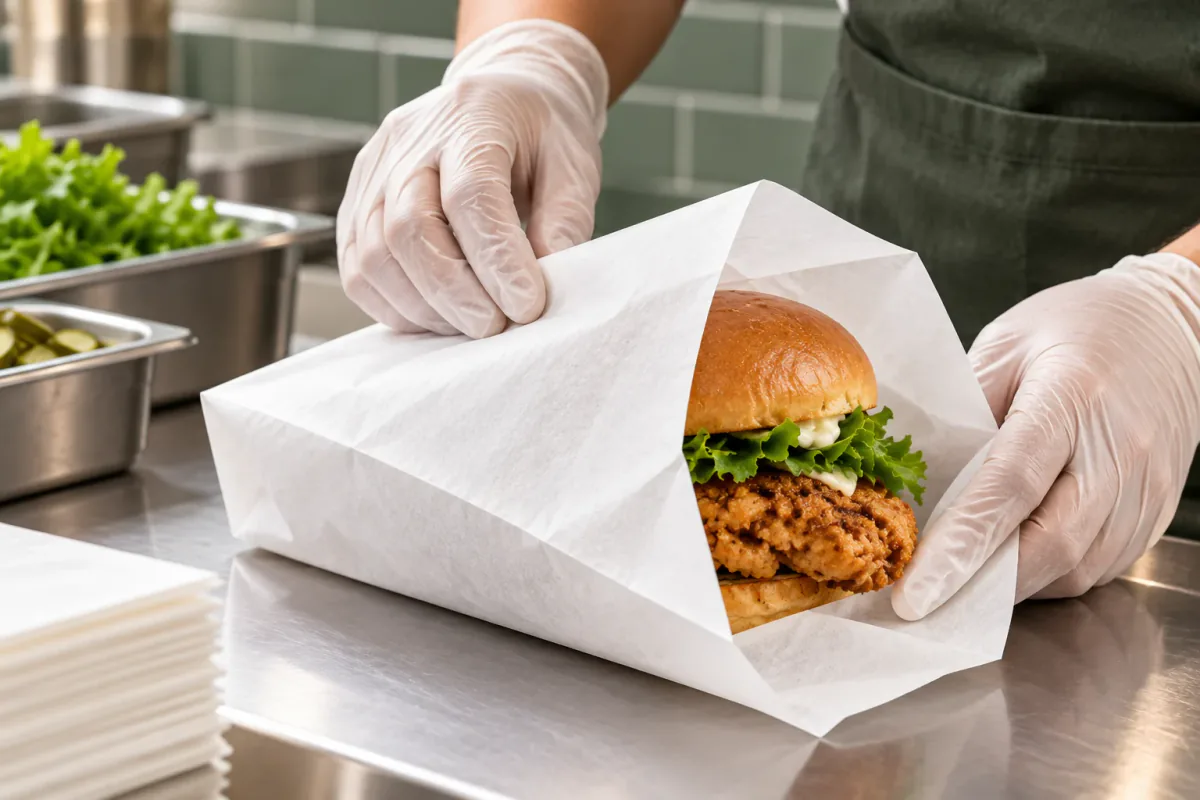
Remove newspaper from the food packing bench. Keep approved candidate sheets at the point of service. Train staff to identify the correct roll or cut sheet. Use a plain outer bag or carton around a suitable primary food wrap, and assess any likely contact during handling.
08 / Evidence
What a test report covers
Read the report before relying on a logo. Check the laboratory name, accreditation, sample description, date, method, result and stated conditions. Match the grade, GSM, coating, ink and finished construction to your purchase specification. A different grade or a different contact-side coating calls for a new review.
Migration describes substances moving from a material into food or a test medium. FSSAI defines the term and sets numeric overall and specific migration limits for plastic materials. Do not copy those plastic limits into a paper specification. Ask which paper or board tests apply to the exact construction and food use.
A supplier test and your kitchen trial answer different questions. The supplier document addresses the stated material standard. Your trial shows whether a sheet folds, releases and resists your food under real work conditions. Use both. A clean kitchen trial alone does not establish chemical suitability.
09 / Buying
Write a direct-contact purchase brief
Tell the supplier the food, contact side, contact time and temperature. Add fat and moisture level, format, GSM, print position and any heating or cooling step. State whether the sheet is a primary wrap, a tray liner, a separator or an outer carton. Ask for the applicable standard and a report on the final construction.
Ask for samples from the intended grade and GSM. Run the samples through your own packing line. Record the result beside the supplier documents. If you change the coating, print, adhesive or paper source later, review the evidence again before treating the new construction as the same material.
Keep the approved specification with your purchase order. Record the document version and the material named in the certificate. On delivery, compare the batch label and physical sheet with the approved sample. Raise any mismatch before food touches the new stock.
10 / Our range
Where KEIKO papers fit
For a baking tray, start with the silicone-coated butter-paper type and the stated 230 °C rating. For a light food wrap, compare the butter-paper formats against your food. For oily food, compare white and brown OGR. Those are product-selection starting points, not blanket compliance claims.
For industrial wrapping and an outer carton, review kraft and bleached kraft. Our kraft grade page says the standard kraft grade is not for direct food contact. The bleached kraft page asks buyers to check before food use. Do not replace the contact liner with either grade on appearance alone.
We have no published batch food-contact certificate, migration report, barrier chemistry or KIT value for the range. Send us the exact job and document list your food business needs. We will state what evidence is available for the candidate grade before you approve a direct-contact purchase.
On this topic
Every page in this guide
Guides
- Is butter paper food safe?
Butter paper safety depends on the type and the food use. Check KEIKO paper types, the 230 °C silicone-coated rating and the documents to request.
- Is kraft paper food safe?
Kraft colour and strength do not prove food-contact suitability. Check the contact side, liner and documents before using kraft around food.
- Is recycled paper safe for food?
Recycled fibre does not prove or rule out food-contact suitability by itself. Check the finished paper, contact layer and evidence for your food use.
- Newspaper food wrapping ban in India
FSSAI bars newspaper for storing and wrapping food. Read the rule, the June 2026 direction and a practical switch for food counters and takeaways.
- Printing ink and food contact safety
FSSAI requires food-package inks to meet IS 15495 and printed faces to stay away from food. Check the final wrap, contact side and documents.
Glossary
- Migration test
A migration test checks substances moving from packaging into food or a test medium. Learn what the report covers and why paper needs its own evidence.
Questions
Before you specify
Does brown paper count as food grade?
Colour does not establish suitability. Ask for evidence on the exact brown paper, its treatment and your intended food use.
Does a food-grade sheet belong in an oven?
Food contact and oven heat are separate checks. KEIKO rates its silicone-coated butter-paper type to 230 °C. We publish no oven rating for our two uncoated butter-paper types.
What documents should a food business request?
Ask for the material specification, applicable standard and a NABL-accredited certificate of conformity for the direct-contact construction under the FSSAI rules.